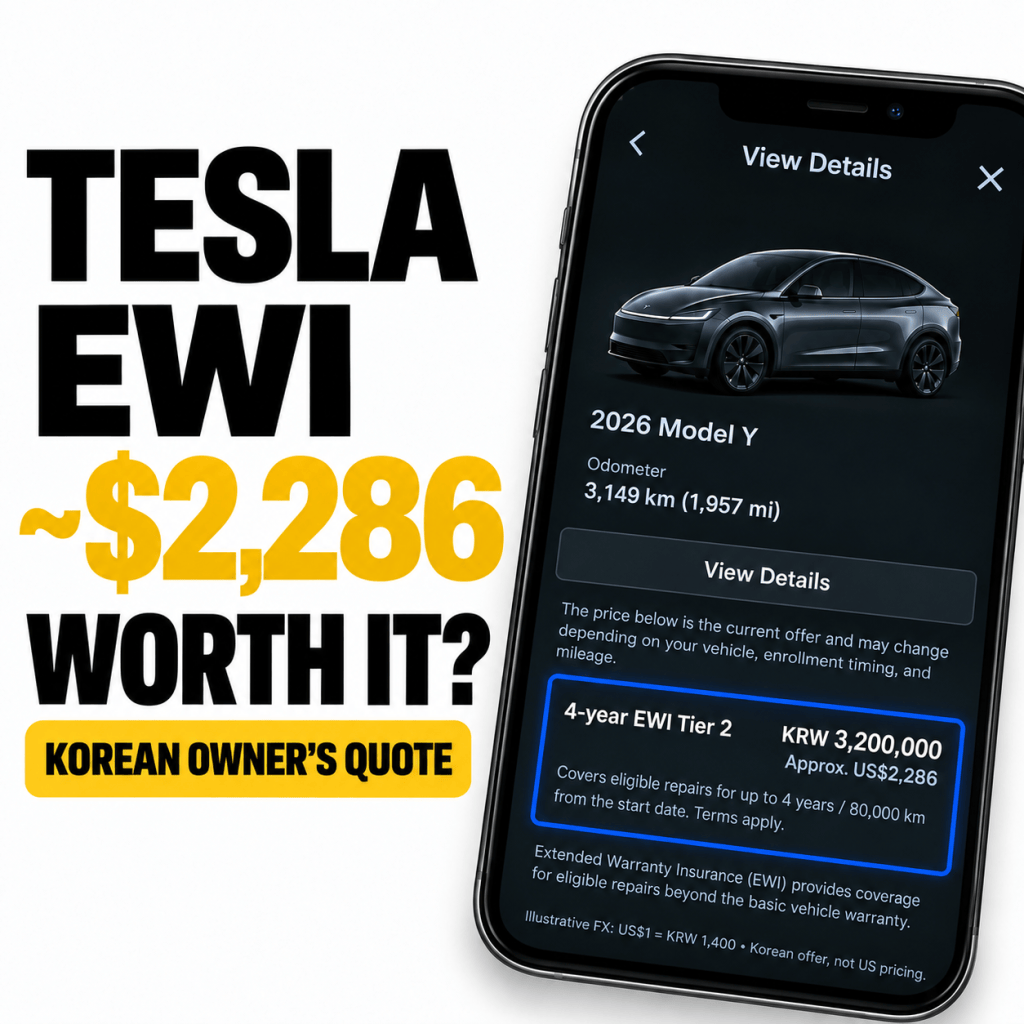
When I checked the Tesla app, it quoted ₩3,200,000—roughly $2,300—for four years of Extended Warranty Insurance, labeled Tier 2, for my Model Y.
That was enough money to make me pause.
Instead of buying it on the spot, I read what the plan covers and looked up parts prices for my own car. I wanted to know how much repair work it would take to justify the upfront cost—and whether that was even the right way to think about it.
A note for readers outside South Korea: I’m a Model Y owner in Dongtan, South Korea. This article covers the Korean EWI product and Korean parts prices, not US coverage or repair pricing. Dollar figures use an illustrative rate of ₩1,400 per US dollar, not a live exchange rate.
The Short Version
- My Tesla app quoted ₩3.2 million for four years of EWI coverage, at Tier 2.
- EWI is a separate service product that begins after the Basic Vehicle Limited Warranty ends.
- Parts prices put the quote in perspective, but what matters is the total cost of covered repairs, including labor.
What My Tesla App Actually Offered
My Model Y had 3,149 km on the odometer—about 2,000 miles—when I checked the offer.
The app showed:
4-year EWI · Tier 2 · ₩3,200,000
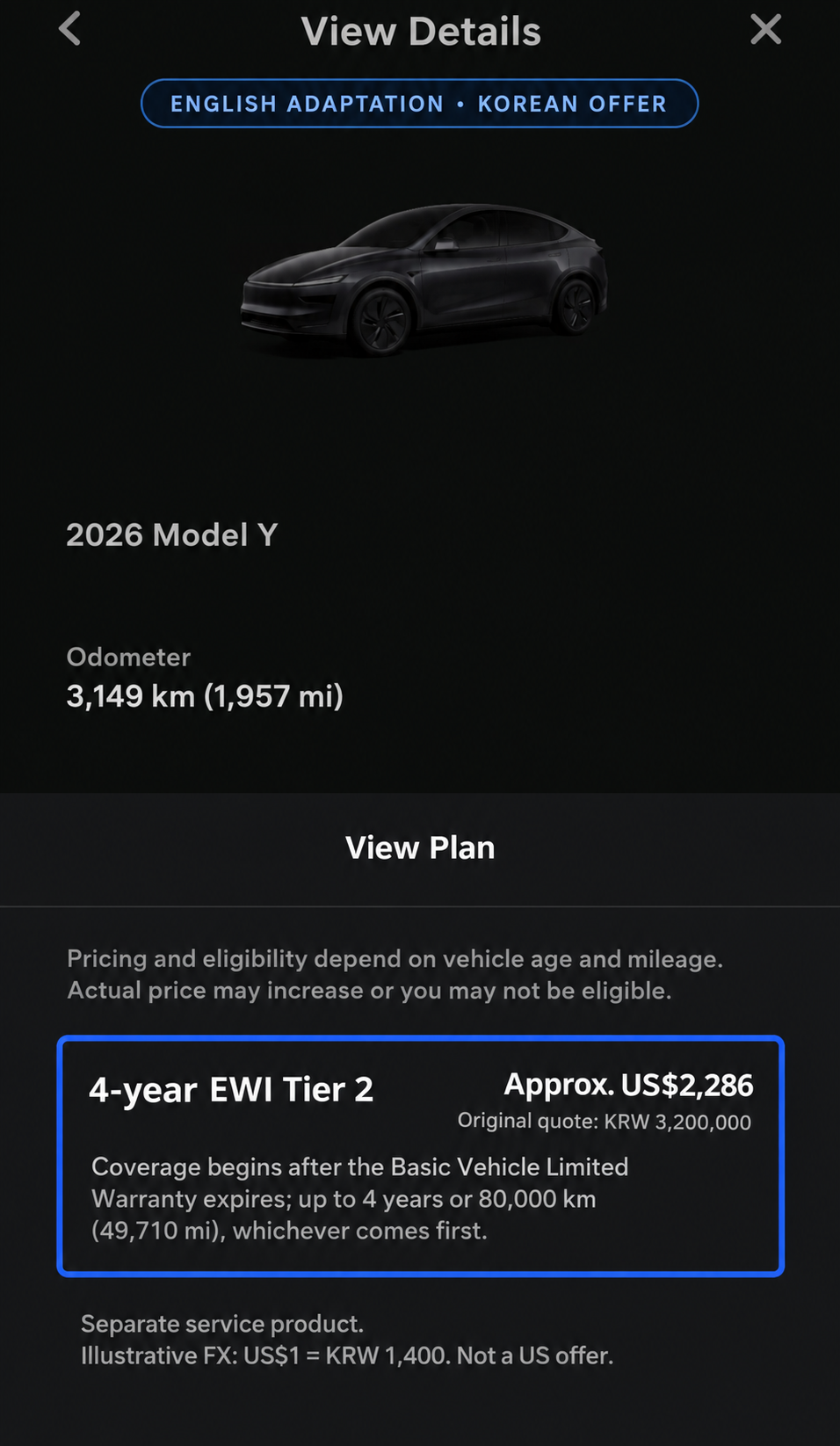
That’s the offer I’m evaluating here. It isn’t a universal Model Y price.
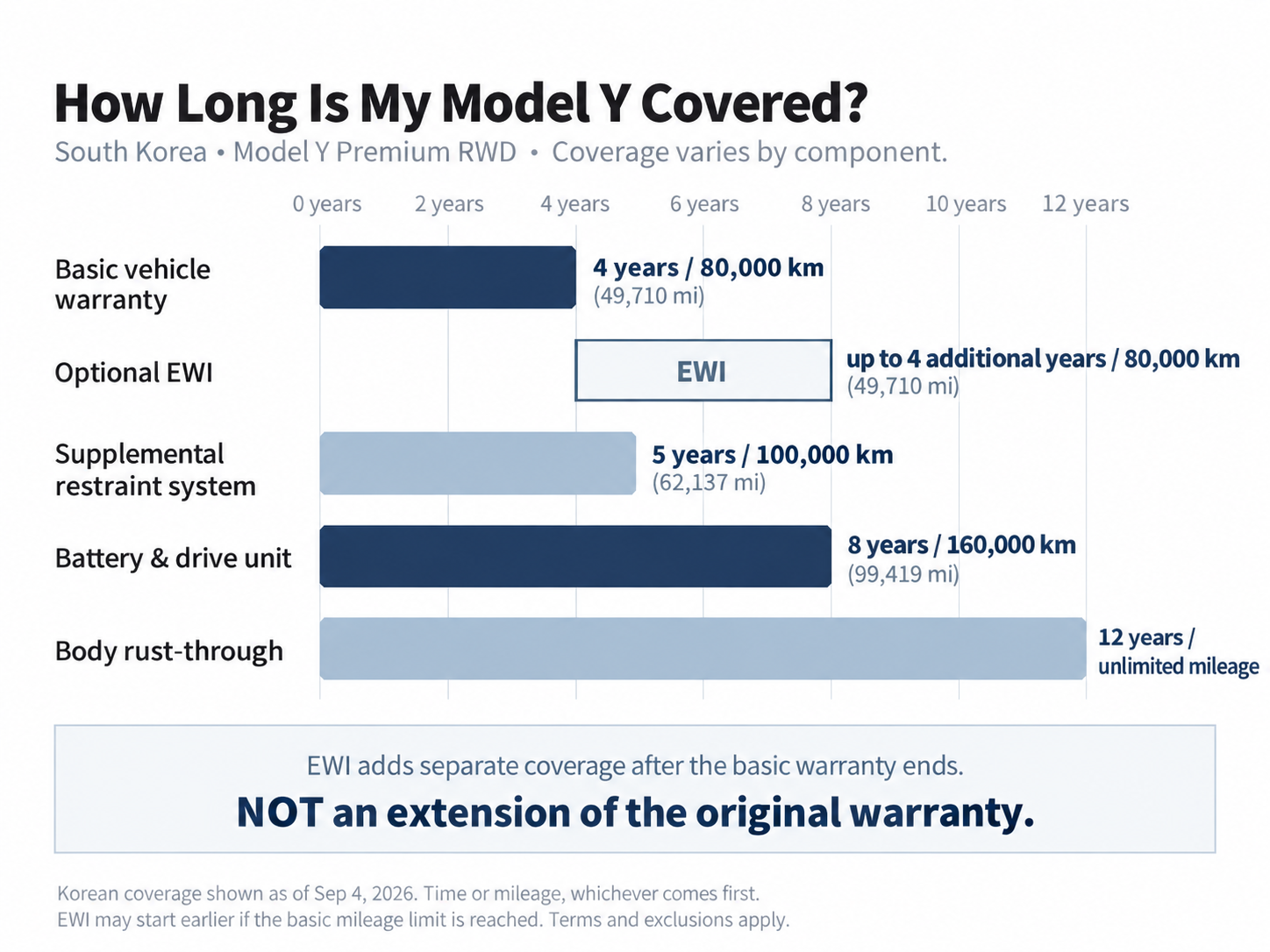
Tesla’s Korean support page describes EWI as providing coverage for up to four years or 80,000 km—about 50,000 miles—from its start date, whichever comes first.
Tesla also specifies that EWI is a separate service product, not an extension of the original Basic Vehicle Limited Warranty. Its terms and coverage can differ. Tesla Korea’s EWI overview
What Are You Actually Paying For?
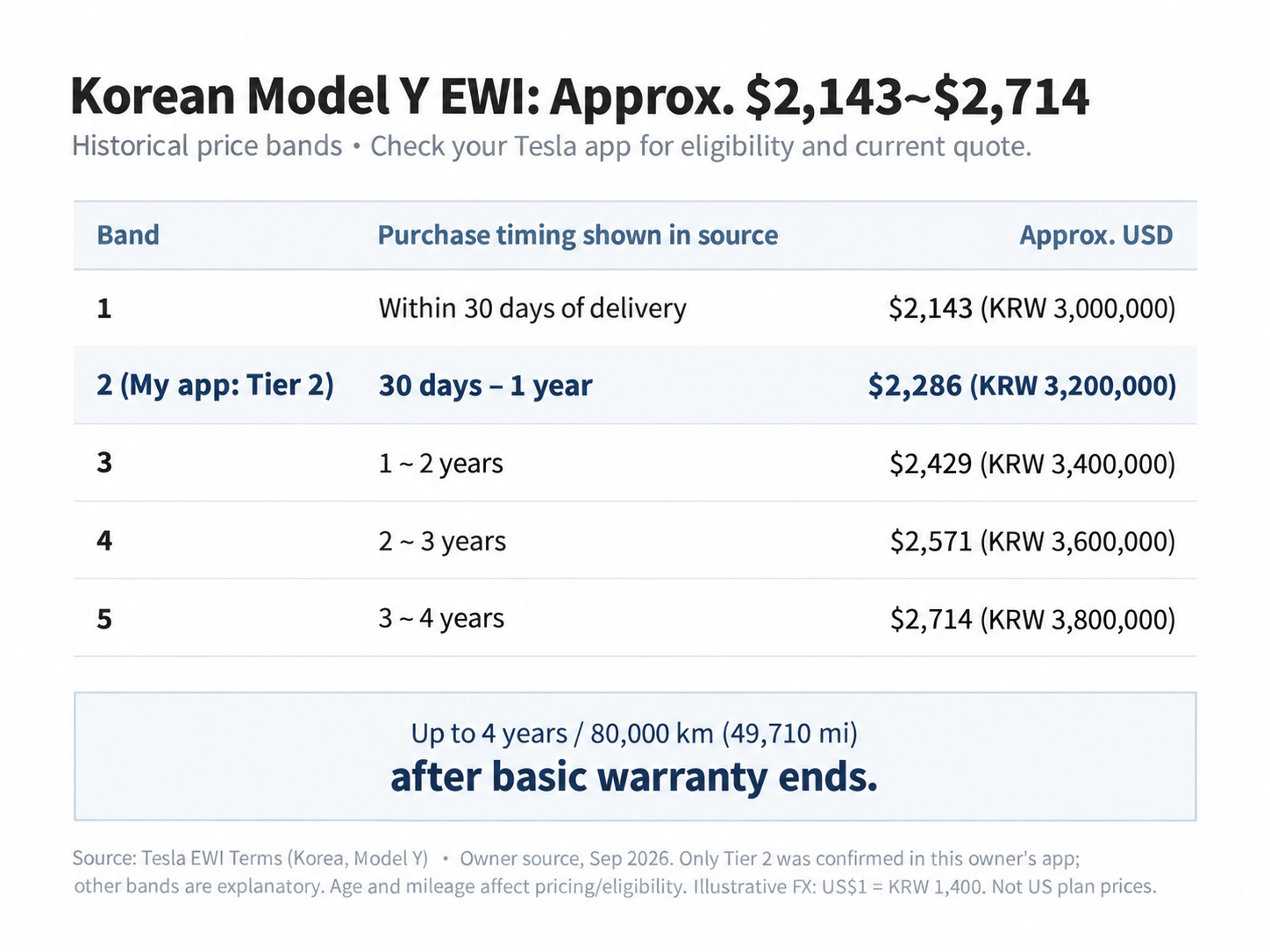
It helps to separate three types of protection:
| Protection | What it covers |
|---|---|
| Auto insurance | Accident damage and other insured events, depending on the policy |
| Basic Vehicle Limited Warranty | Covered defects during the original warranty period |
| Korean EWI | Eligible mechanical or electrical failures under the plan’s terms after the basic warranty ends |
A phone makes a useful comparison. Dropping it and cracking the screen is different from an internal component failing during normal use.
The same distinction applies to a car. EWI doesn’t mean every problem after year four gets fixed for free. The cause of the failure, the exclusions, and the claim decision still matter.
Why Labor Changes the Comparison
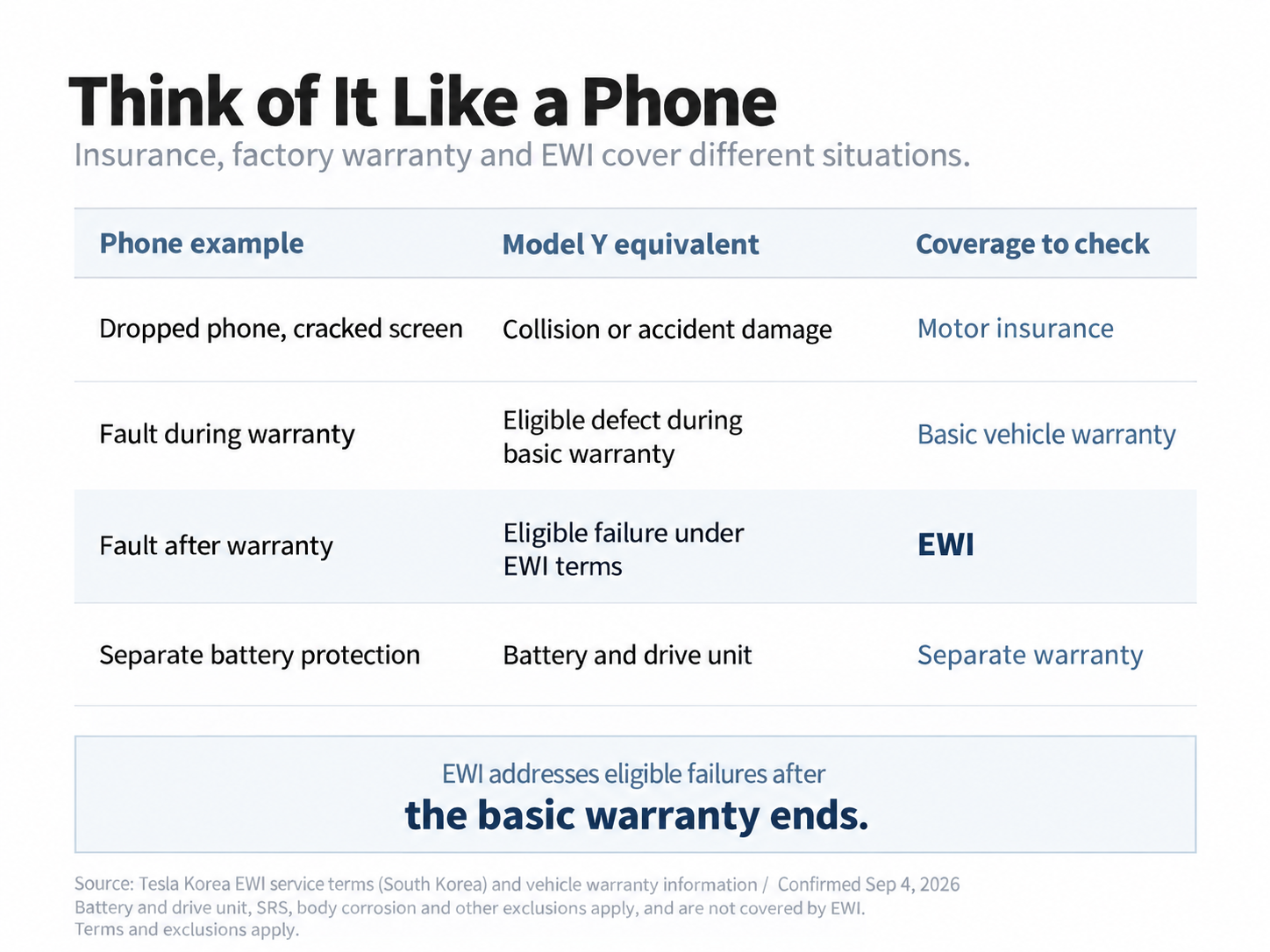
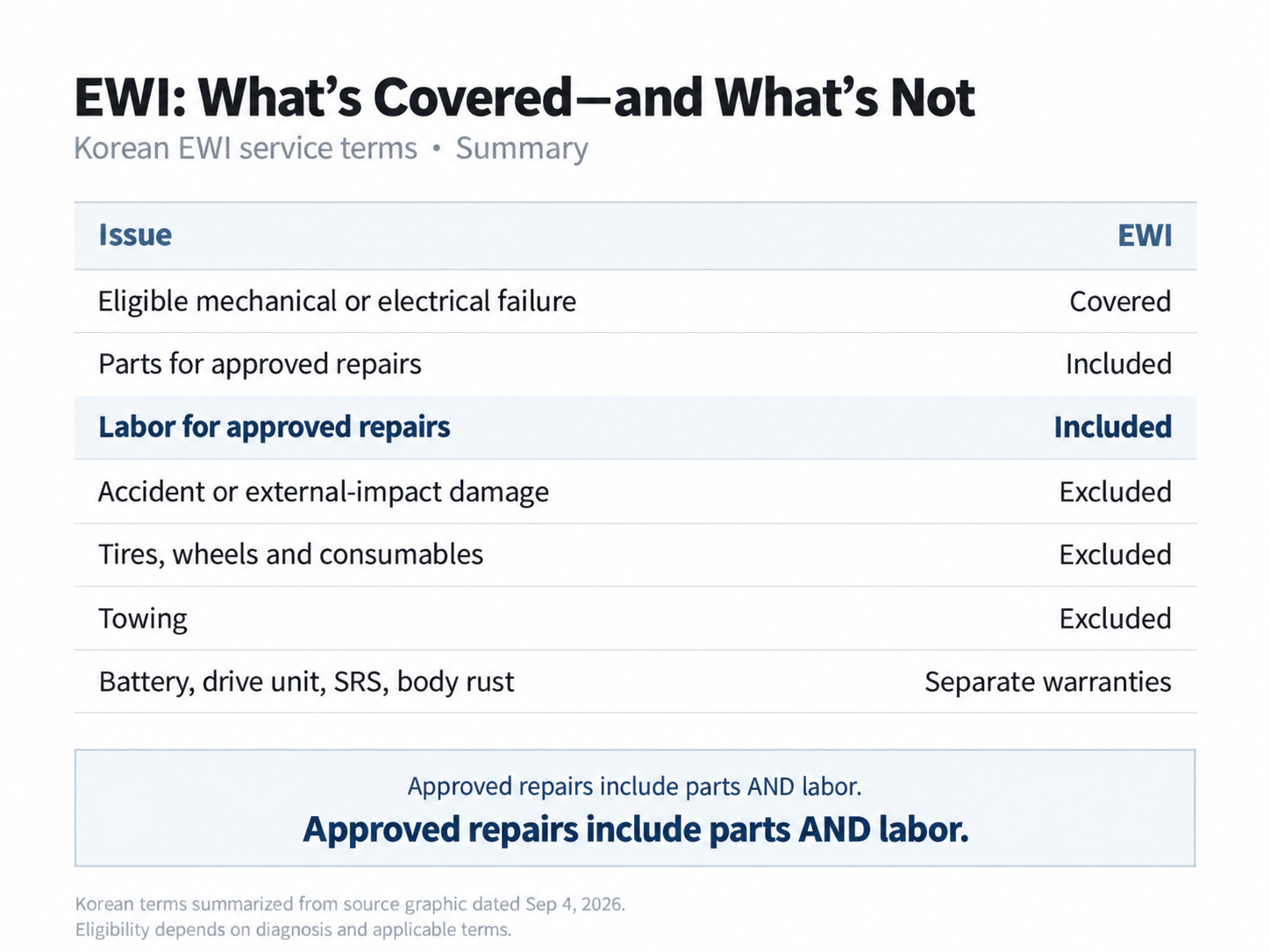
One detail stood out when I read the terms: approved EWI repairs cover both parts and labor.
That makes a parts-only comparison incomplete.
A catalog price tells me what a component costs. It doesn’t tell me the total cost of diagnosing the problem, accessing the component, replacing it, and finishing the job.
At the same time, I can’t assume every line on a service invoice will be covered. Work outside the plan’s terms can still leave me with a bill.
My takeaway was simple: compare the EWI price with the total cost of covered repairs, including parts and labor.
Keep Battery Coverage Separate
My Model Y’s battery and drive unit have their own warranty, which Tesla lists separately from the Basic Vehicle Limited Warranty. Tesla Korea’s vehicle warranty information
I didn’t count a hypothetical high-voltage battery replacement as a reason to buy EWI. The EWI terms I reviewed exclude the battery and drive unit, along with other separately addressed items.
If you’re considering the plan, check the agreement that applies to your own car.
The battery warranty and EWI answer different ownership questions.
The Model Y Parts Prices I Found
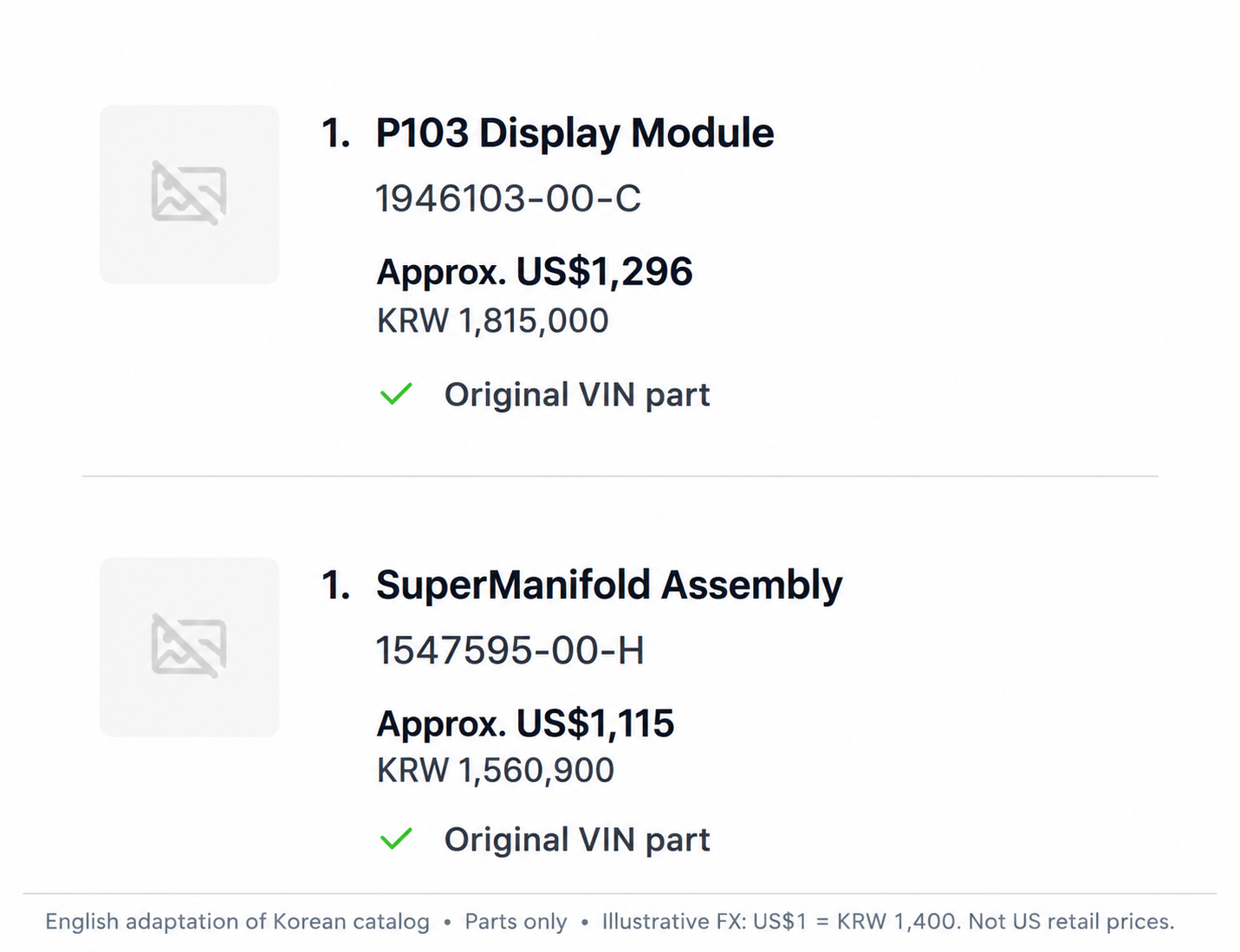
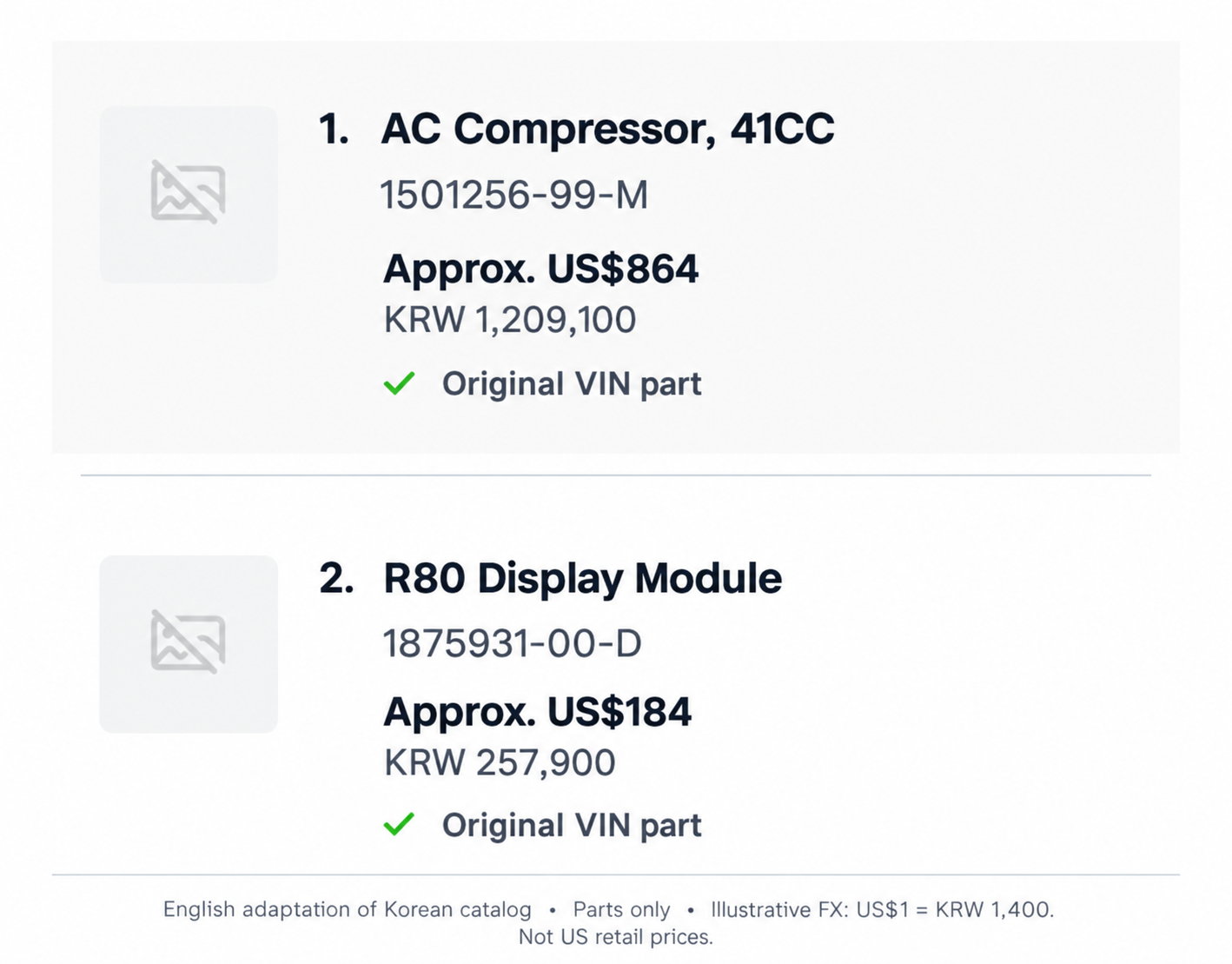
To give the ₩3.2 million quote some context, I checked Tesla’s official parts catalog using my VIN.
Here’s what I recorded:
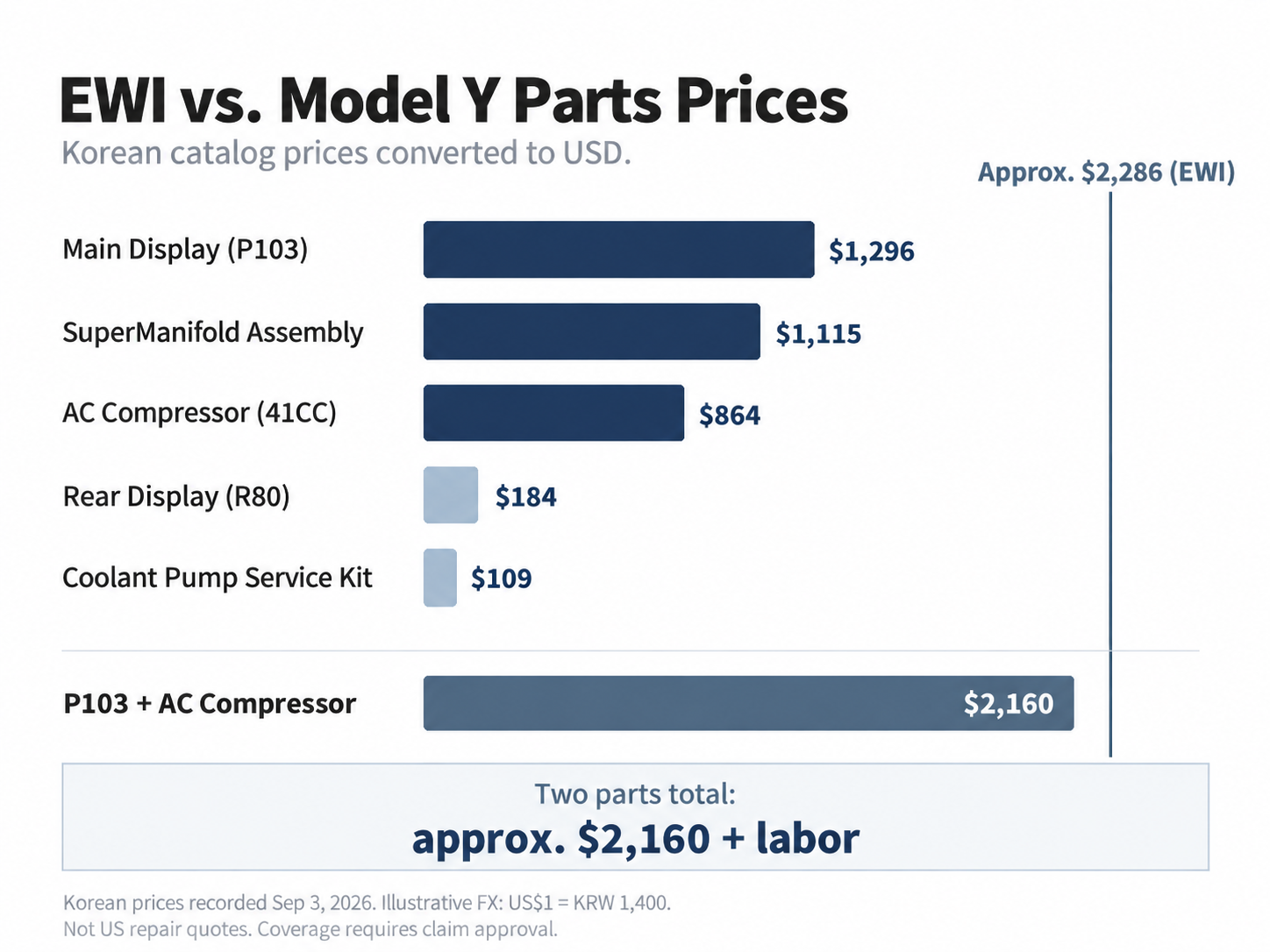
| Part | Korean catalog price | Approx. USD |
|---|---|---|
| P103 display module | ₩1,815,000 | $1,296 |
| SuperManifold assembly | ₩1,560,900 | $1,115 |
| AC compressor | ₩1,209,100 | $864 |
| R80 display module | ₩257,900 | $184 |
These are catalog parts prices, not quotes for completed repairs. Dollar figures are illustrative conversions of Korean prices. Confirm compatibility, current pricing, labor, and coverage for your own car.
Two Parts Nearly Add Up to the EWI Price
As a simple example, I added the P103 display module and the AC compressor:
₩1,815,000 + ₩1,209,100 = ₩3,024,100
That’s about $2,160, and only ₩175,900—roughly $125—below the EWI quote.
If both components needed replacing, labor could push the combined repair cost above ₩3.2 million.
But that comparison only works if:
- Both failures occur during the coverage period.
- Both failures qualify under the EWI terms.
- The repairs require replacing those components.
- The costs remain covered within any applicable contract limits.
This illustrates what repairs could cost. It isn’t a prediction that these parts will fail.
I haven’t experienced either failure, and the catalog says nothing about how likely they are.
Expensive Parts Don’t Automatically Make EWI a Good Deal
Finding expensive components changed how I viewed the price. It didn’t prove I should buy the plan.
There are two separate questions:
- Could covered repairs cost more than ₩3.2 million?
The parts prices show how that could happen, especially once labor is included. - Will my car actually need that much covered work?
The prices can’t answer that.
There’s a timing question too. Buying EWI means paying now for protection against future costs. Keeping the money means it stays available, and I pay for repairs if they arise.
If my car has no major covered failures, I’d be financially better off keeping the money. If it needs enough expensive, covered repairs, EWI could pay for itself.
A parts catalog can’t tell me which outcome to expect.
How I’d Make the Decision
For me, it comes down to one question:
Would I rather pay roughly $2,300 upfront, or keep that money available and accept the risk of future repair bills?
| EWI may suit you if… | A repair fund may suit you if… |
|---|---|
| You plan to keep the car well into the coverage period | You expect to sell before using much of the coverage |
| You can afford the upfront payment and value protection against larger covered bills | You can comfortably absorb an unexpected repair bill |
| You prefer paying upfront to reduce uncertainty about covered repair costs | You prefer keeping the money available and accepting the risk |
| You’ve reviewed the exclusions and the plan addresses your concerns | The exclusions leave your main concern uncovered |
Buying EWI doesn’t remove every ownership risk. It reduces your exposure to the repairs the contract covers.
My Verdict on the ₩3.2 Million Quote
After reviewing the parts prices, I can see why an owner would consider EWI.
A display module at about $1,296, a SuperManifold assembly at $1,115, and a compressor at $864 make the potential cost of major repairs tangible. Labor adds to those costs.
But expensive parts aren’t evidence that my car will need expensive repairs.
My conclusion: EWI could save me money if my car needs enough costly, covered repairs. Whether that protection is worth the upfront payment depends on how long I keep the car, what the agreement covers, and how comfortably I could handle a repair bill myself.
I’m treating it as a decision about repair-cost uncertainty—not a plan to “get my money’s worth” through breakdowns.
For my Model Y, the starting point was Tier 2 at ₩3.2 million, or roughly $2,300. Your starting point should be your own quote and the agreement offered in your market.
Quote and parts-price reference: September 2026.
Official product information: Tesla Korea EWI. For detailed coverage, exclusions, and limits, consult the applicable service agreement on the Korean EWI website.
Shopping for Model Y Accessories in Korea?
I also built a Tesla accessories price-comparison page that compares accessory prices across retailers serving Korean buyers.
The page is in Korean. International availability, shipping, and final prices may differ.
Some links on the comparison page are affiliate links. I may earn a commission from qualifying purchases.


Leave a comment