When I was shopping for a Tesla Model Y, one of the biggest questions I had was simple:
How much does it actually cost to charge?
People often say EVs are cheaper to run than gasoline cars, but that does not answer the real question. I wanted to know the actual number, based on real charging bills and real driving data.
So I looked at my own charging history and my actual efficiency from driving my Tesla Model Y Juniper RWD in Korea.
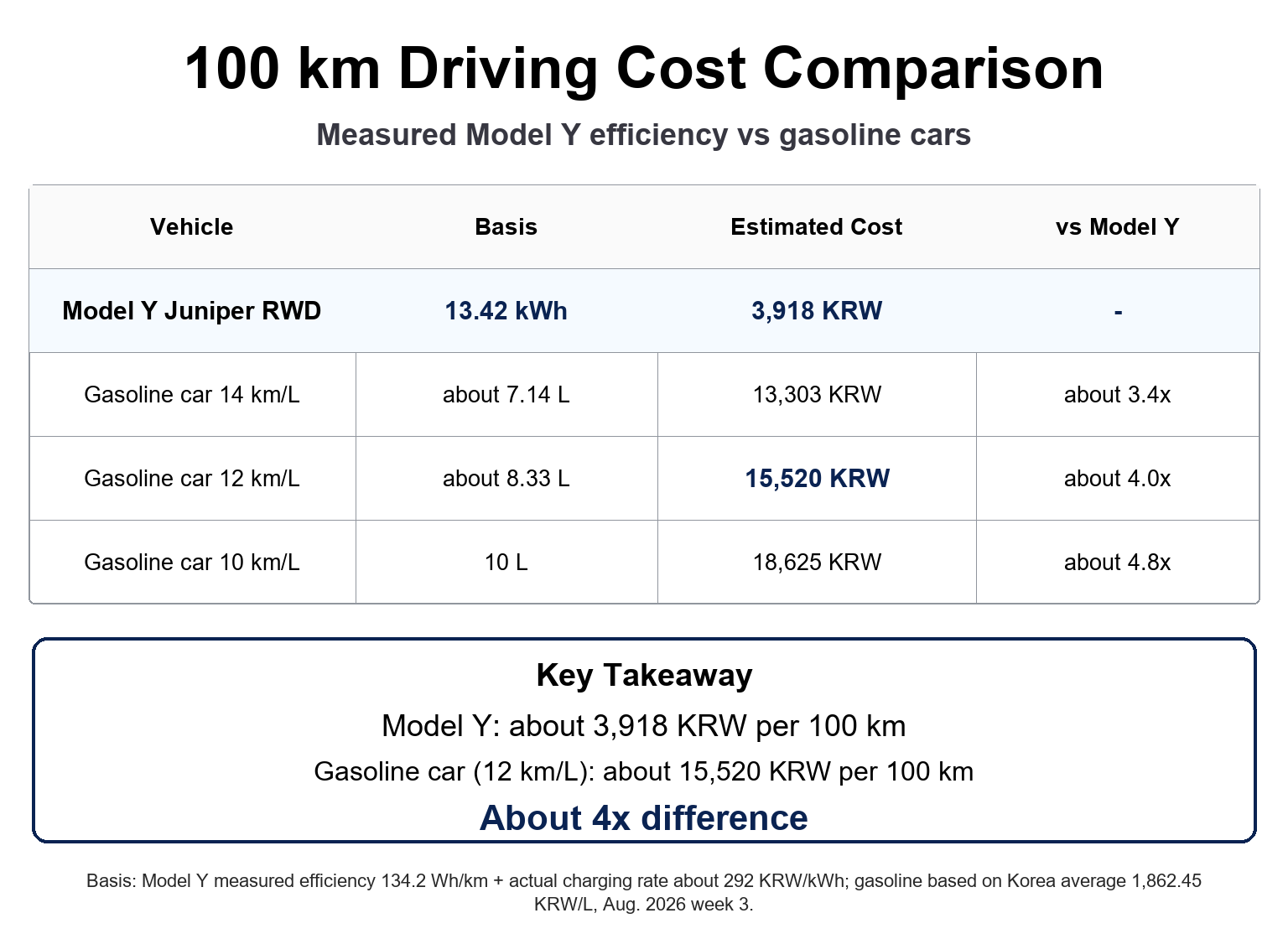
The short answer: based on my slow-charging rate and real-world efficiency, my Model Y cost about 3,918 KRW per 100 km.
For comparison, a gasoline car getting 12 km/L would cost about 15,520 KRW per 100 km using the fuel price I used for this calculation.
In this specific case, the gasoline car cost about four times more to drive the same distance.
Quick Summary
- My actual average slow-charging price was about 292 KRW/kWh.
- My measured efficiency was 134.2 Wh/km, or about 7.45 km/kWh.
- My Tesla Model Y cost about 3,918 KRW per 100 km.
- A gasoline car getting 12 km/L cost about 15,520 KRW per 100 km.
- At 1,000 km per month, the difference was about 116,000 KRW per month.
- At 12,000 km per year, the difference was about 1.39 million KRW per year.
My Actual Charging Data
First, I checked what I actually paid.
From August 1 to August 23, I charged 16 times using PlugLink in Korea.
The total charging amount was 194.104 kWh, and the total amount I paid was 56,668 KRW.
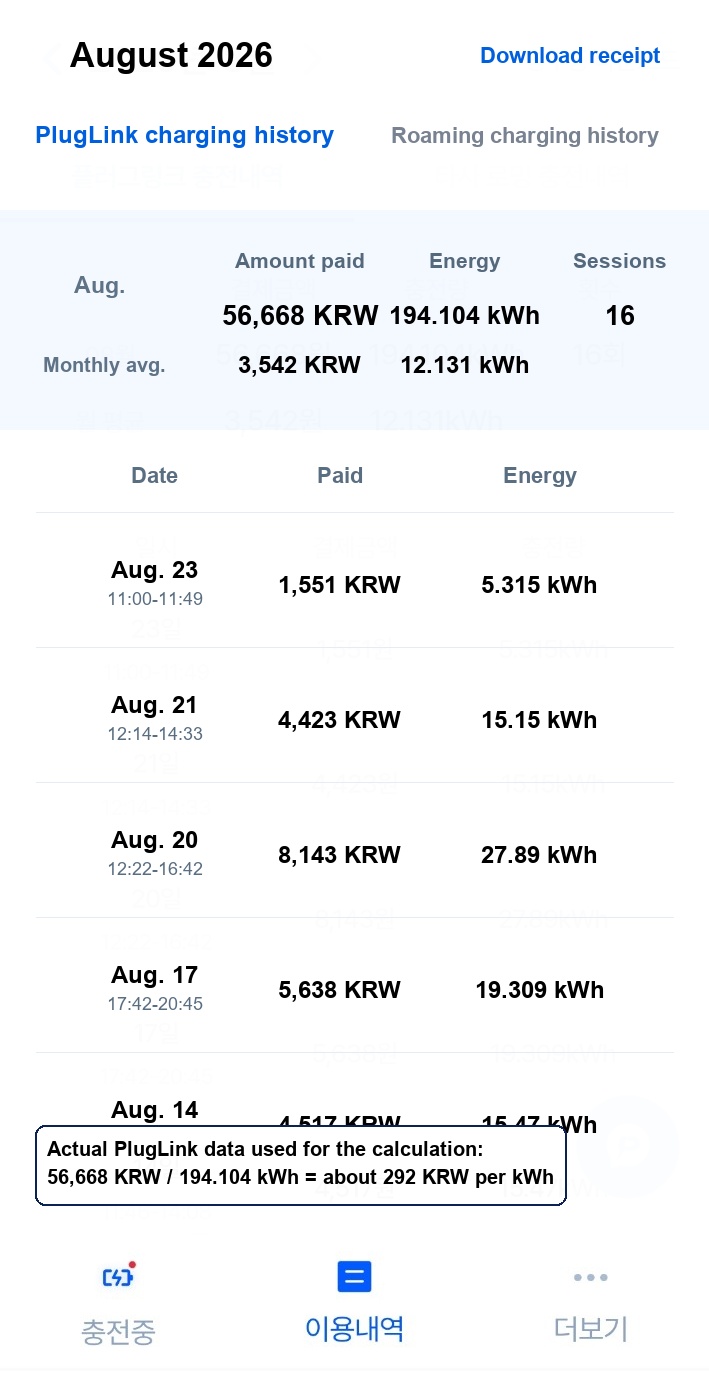
That means:
56,668 KRW / 194.104 kWh = about 291.95 KRW/kWh
To keep the calculation simple, I used 292 KRW/kWh.
This is not a random charging price from the internet. It is based on what I actually paid.
One important note: 56,668 KRW was not my full monthly charging cost. It was the amount I paid from August 1 to August 23.
My Real-World Model Y Efficiency
The next number I needed was real-world efficiency.
For this drive, my Model Y recorded:
- Distance: 118.4 km
- Energy used: 15.9 kWh
- Average efficiency: 134.2 Wh/km
- Driving time: 1 hour 45 minutes
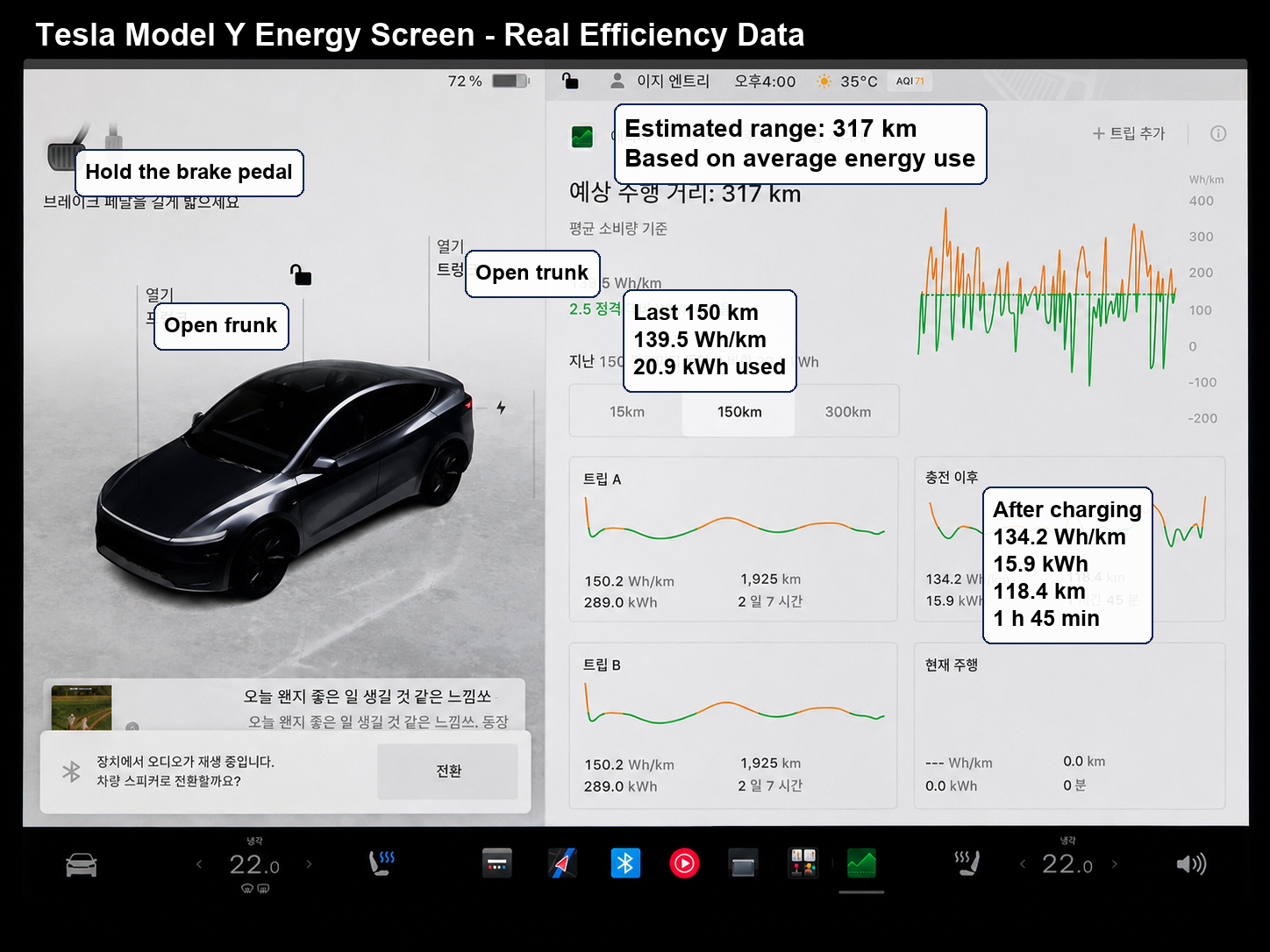
The outside temperature was around 29°C at departure and 35°C at arrival, and I used the air conditioner.
134.2 Wh/km is about 7.45 km/kWh.
That means driving 100 km would require about 13.42 kWh.
Using my actual charging price:
13.42 kWh × 292 KRW = about 3,918 KRW
So under these conditions:
Tesla Model Y driving cost per 100 km = about 3,918 KRW
Tesla Model Y vs Gasoline Car: 100 km Cost
To make that number easier to understand, I compared it with gasoline cars.
For gasoline, I used the Korea National Oil Corporation Opinet average regular gasoline price for the third week of August 2026: 1,862.45 KRW/L.
Because fuel economy varies by car, I compared three gasoline-car scenarios:
| Vehicle Type | Efficiency | Cost per 100 km |
|---|---|---|
| Tesla Model Y | 134.2 Wh/km | 3,918 KRW |
| Gasoline car | 14 km/L | 13,303 KRW |
| Gasoline car | 12 km/L | 15,520 KRW |
| Gasoline car | 10 km/L | 18,625 KRW |
Using the middle case, 12 km/L:
3,918 KRW vs 15,520 KRW
That is about 11,600 KRW difference per 100 km.
In this calculation, the gasoline car cost roughly four times more to drive.
Source: Korea National Oil Corporation Opinet, third week of August 2026 national average regular gasoline price.
Will a Model Y Always Cost 3,918 KRW per 100 km?
No.
This is important.
My result was based on a specific summer drive, my charging provider, my driving conditions, and my measured efficiency.
Tesla’s official combined efficiency for the Model Y Premium RWD in Korea is 5.6 km/kWh, which is lower than the 7.45 km/kWh I saw on this drive.
Real-world efficiency changes depending on temperature, speed, traffic, elevation, passengers, cargo, heating, air conditioning, tire setup, and driving style.
So this does not mean every Model Y will always cost 3,918 KRW per 100 km.
A more accurate way to say it is:
In my summer driving conditions, using my actual slow-charging rate, I got about 3,918 KRW per 100 km.
If I use Tesla’s official combined efficiency of 5.6 km/kWh with my actual charging price, the cost becomes closer to about 5,200 KRW per 100 km.
That is still much cheaper than the 12 km/L gasoline-car example.
Monthly Charging Cost: 1,000 km per Month
A 100 km number is useful, but monthly cost is easier to feel in real life.
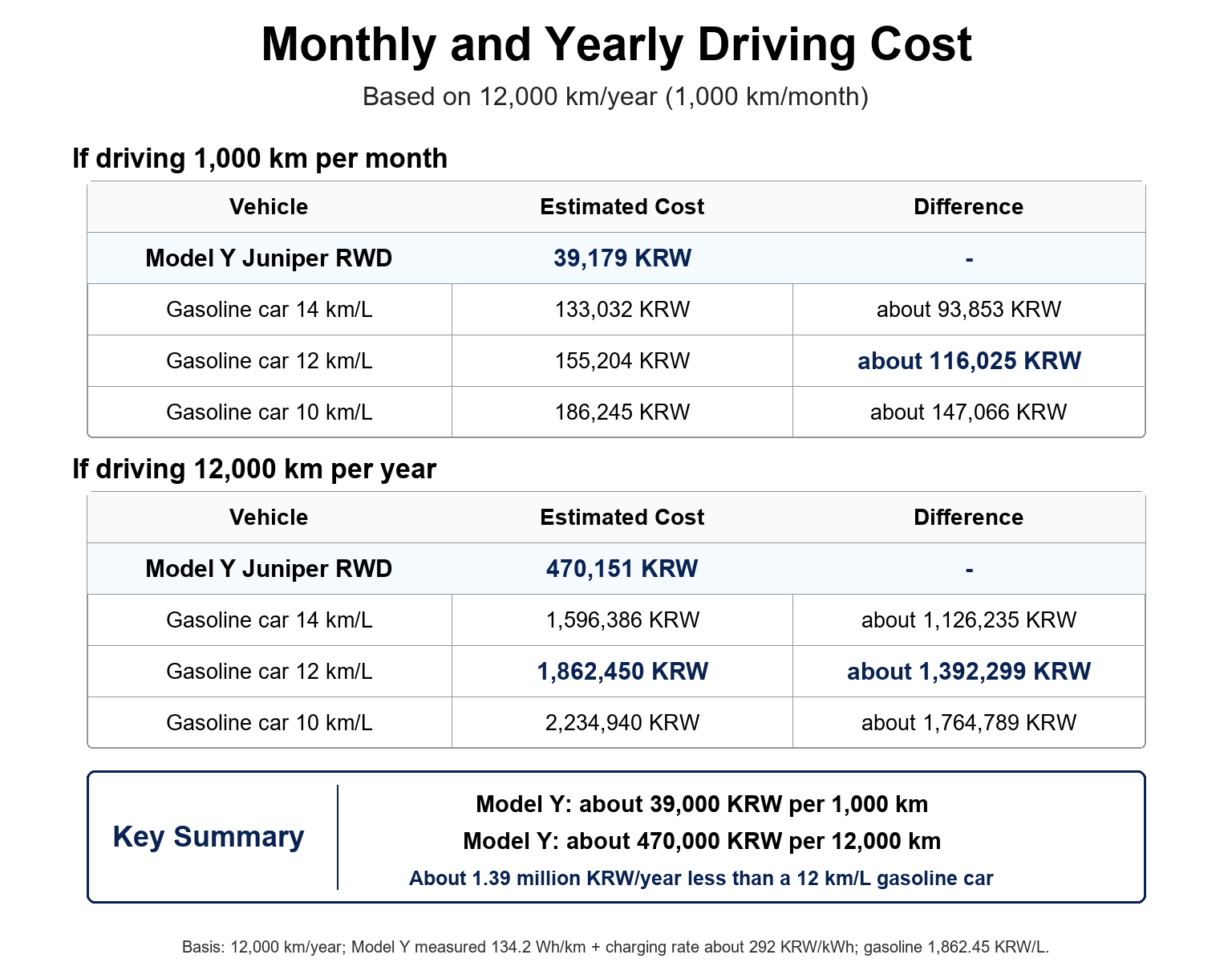
So I calculated the cost based on 1,000 km per month.
That is about 12,000 km per year, or around 33 km per day.
| Vehicle Type | Monthly Driving Cost at 1,000 km |
|---|---|
| Tesla Model Y | 39,179 KRW |
| Gasoline car, 14 km/L | 133,032 KRW |
| Gasoline car, 12 km/L | 155,204 KRW |
| Gasoline car, 10 km/L | 186,245 KRW |
Compared with a 12 km/L gasoline car:
Model Y: about 39,000 KRW/month
Gasoline car: about 155,000 KRW/month
That is a difference of about 116,000 KRW per month.
Yearly Driving Cost: 12,000 km per Year
Using the same numbers for a full year:
| Vehicle Type | Yearly Driving Cost at 12,000 km |
|---|---|
| Tesla Model Y | about 470,000 KRW |
| Gasoline car, 14 km/L | about 1.6 million KRW |
| Gasoline car, 12 km/L | about 1.86 million KRW |
| Gasoline car, 10 km/L | about 2.23 million KRW |
Compared with a 12 km/L gasoline car:
Model Y: about 470,000 KRW/year
Gasoline car: about 1.86 million KRW/year
That is a difference of about 1.39 million KRW per year.
I already knew EVs were cheaper to drive, but seeing the number on a yearly basis made the difference feel much more real.
Slow Charging vs Fast Charging
One key reason my cost was low is that I mainly used slow charging.
My actual average charging price was about 292 KRW/kWh.
If you rely heavily on Tesla Superchargers or other fast chargers, your cost per kWh will likely be higher. That means your cost per 100 km will also be higher.
So when people ask, “How much does it cost to charge a Model Y?” the better question is:
Where will you usually charge?
If you can use slow charging at home, an apartment, or a regular parking location, your cost may be close to this kind of calculation.
If you mostly use fast charging outside, your result may be very different.
For Readers Outside Korea
This article is based on my actual charging cost and gasoline-price comparison in Korea. Charging prices, gasoline prices, incentives, taxes, and electricity plans vary heavily by country.
If you live outside Korea, the exact numbers will be different. The useful part is the method: use your real kWh price, your real driving efficiency, and your local gasoline price to compare the cost per 100 km.
Useful Resource: Tesla Parts Price Comparison
If you are also shopping for Model Y accessories, I made a simple price-comparison page for Tesla parts and accessories.
Disclosure: Some links on that comparison page may be affiliate links. If you buy through those links, I may earn a small commission at no extra cost to you.
Final Verdict
Based on my actual charging bills and real-world driving data in Korea, my Tesla Model Y Juniper RWD cost about:
3,918 KRW per 100 km
That works out to about:
39,000 KRW per 1,000 km
470,000 KRW per 12,000 km
Compared with a gasoline car getting 12 km/L, the difference was about:
116,000 KRW per month
1.39 million KRW per year
This does not mean every Model Y will always be four times cheaper than every gasoline car. Winter efficiency, fast charging, charging losses, fuel prices, and driving style all matter.
But in my real-world conditions, using actual slow-charging payment data, the running-cost advantage of the Model Y was very clear.
When August ends, I plan to check my full monthly charging cost again and compare it with this early result.


Leave a comment